Cognition Is More Than Memory
Remembering Mother's Day and Supporting Friends

When most people hear the word dementia, they think about memory loss.
But cognition is far more complex than remembering names or appointments.
Cognition is the orchestra of abilities that allows us to understand the world, manage our lives, communicate with others, and remain connected to the people we love.
Different parts of cognition can change in different ways.
Some people struggle first with memory.
Others lose words.
Some become less organized or have difficulty making decisions.
Others experience changes in judgment, emotional insight, or the ability to interpret the feelings of others.
Cognition includes many domains:
Memory — remembering information, conversations, and experiences
Attention and concentration — staying focused and processing information
Executive function — planning, organizing, multitasking, and decision-making
Language — speaking, understanding words, reading, and writing
Visuospatial abilities — navigating spaces, judging distance, recognizing objects or faces
Processing speed — how quickly the brain interprets and responds
Insight and judgment — recognizing problems and making safe decisions
Social cognition — understanding emotions, facial expressions, tone of voice, humor, and social cues
Empathy and emotional connection — sensing the feelings of others, responding compassionately, and maintaining emotional reciprocity
Families are often deeply affected not only by forgetfulness, but by changes in emotional connection.
Larry’s dementia is slowly progressing with language difficulty, more frequent anomia, and slower processing of language. He may not recall the names of friends and has more trouble organizing the day or planning activities.
However, his social cognition remains remarkably intact, as do his empathy and emotional connection.
For example, he forgot that last weekend was Mother’s Day. But after I reminded him, he quietly slipped out of the house, walked to CVS, and returned with an orchid. Larry has always given me orchids for Mother’s Day.
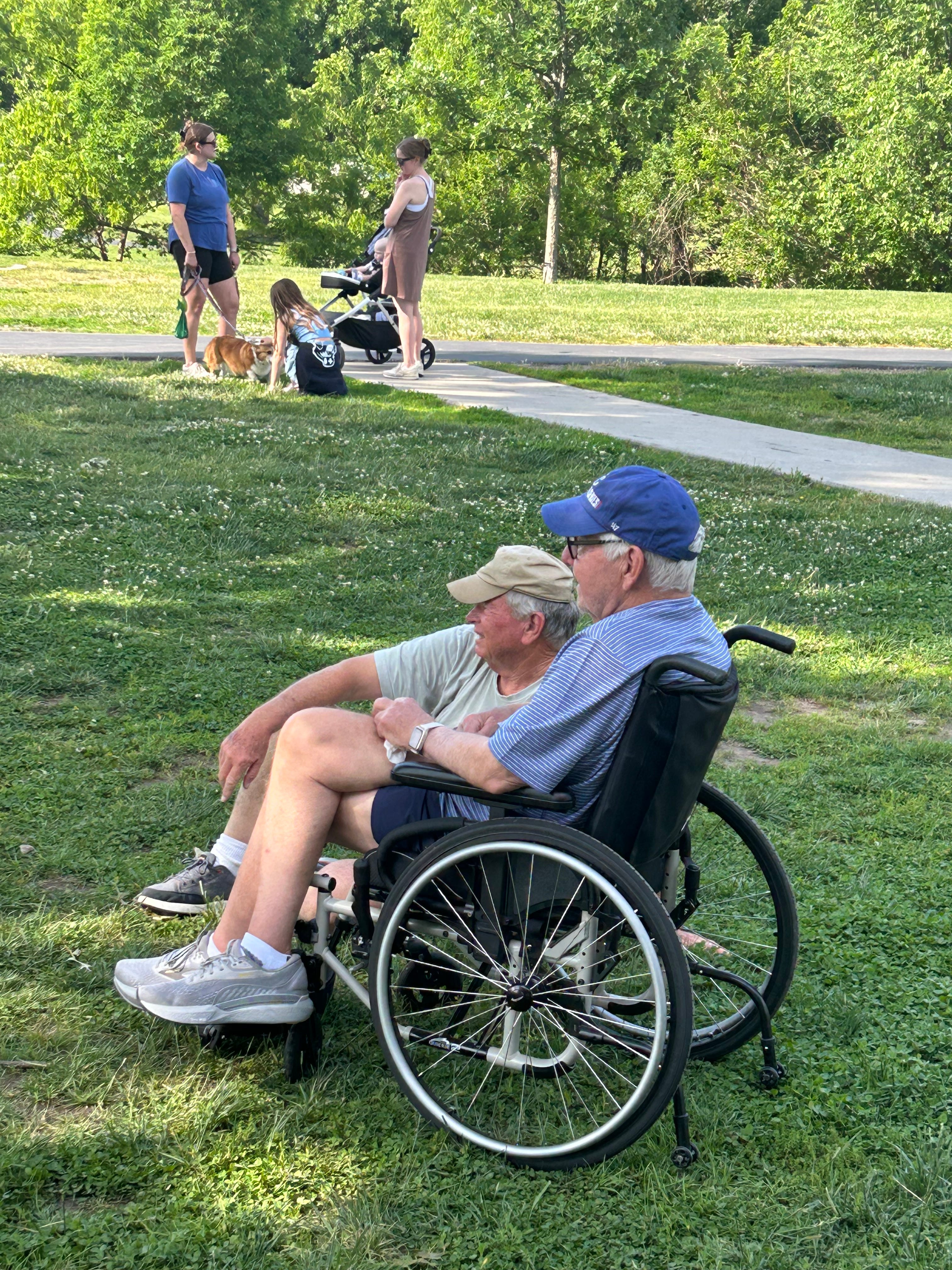
Since arriving in Kansas City in December, we have both been helping a friend who suffered a stroke shortly after our move. Larry has been a tremendous support to his wife — assisting with transfers and even helping him rise after a fall to the floor.
Just this weekend, it was Larry’s idea to take our friend to the park. They sat together talking about their past experiences and quietly sharing the same fear — that neither wanted to become a burden to the people they love.
Last week, Larry was especially attuned to our daughter after she had a difficult experience at work. He remembered her emotions the next day and offered thoughtful and comforting advice.
Larry has always possessed extraordinary emotional intelligence and empathy.
I am celebrating that those qualities remain.
Larry continues to EMBRACE life.
And perhaps that is what living well with dementia truly means.
Not denying loss.
Not pretending things are unchanged.
But recognizing that joy, purpose, connection, humor, generosity, love, and emotional presence can still remain deeply alive.
Our lives are still filled with engagement with our daughters, grandchildren, and Kansas City friends. Helping our friend after stroke has given both of us renewed purpose and the joy that comes from giving to others.
We are blessed.
My EMBRACE model for living well with dementia is not about “fighting” the disease every day. It is about intentionally preserving meaning, connection, dignity, and quality of life.
EMBRACE means:
E — Engage in meaningful relationships and activities
M — Move the body and mind every day
B — Build routines and supportive environments
R — Recognize strengths that still remain
A — Adapt with creativity, patience, and grace
C — Connect with family, friends, and community
E — Emphasize purpose, joy, and emotional well-being
Even as cognition changes, people can still experience love, belonging, usefulness, spirituality, laughter, and emotional connection.
There is still life to be lived.
There is still beauty to be found.
There is still reason to EMBRACE each day.